

Under-Eye Treatments: What Actually Works for Dark Circles, Hollows, and Tired Eyes
The under-eye area is one of the most common concerns we see at Crystalline — and one of the most emotionally loaded. It’s the thing people point to first when they say they look tired even after eight hours of sleep. It’s what catches the light wrong in photos. It’s what makes someone feel like their face doesn’t match how they actually feel.
If you’ve been searching for under eye treatment UK aesthetics and found yourself more confused than when you started, that’s understandable. The information online is inconsistent, often vague, and rarely distinguishes between what can genuinely be done non-surgically and what can’t. So here’s an honest breakdown.
Why the Under-Eye Area Is Uniquely Difficult to Treat

Before getting into what works, it helps to understand why this area presents a specific challenge.
The skin under the eyes is the thinnest on the face — typically around 0.5mm compared to 2mm elsewhere. There’s very little fat padding beneath it. The blood vessels sitting close to the surface show through easily, particularly in those with fair or translucent skin. And as we age, the orbital fat that normally cushions the eye socket begins to shift downward, creating a hollow — the tear trough — that creates shadow regardless of how much sleep you’ve had.
There’s also frequently more than one thing happening at once. Dark circles can be caused by pigmentation, by translucency, by shadowing from a hollow, or by all three simultaneously. The correct treatment depends entirely on which is the dominant cause — which is why a thorough assessment before any treatment is essential.
What Actually Works: Your Options
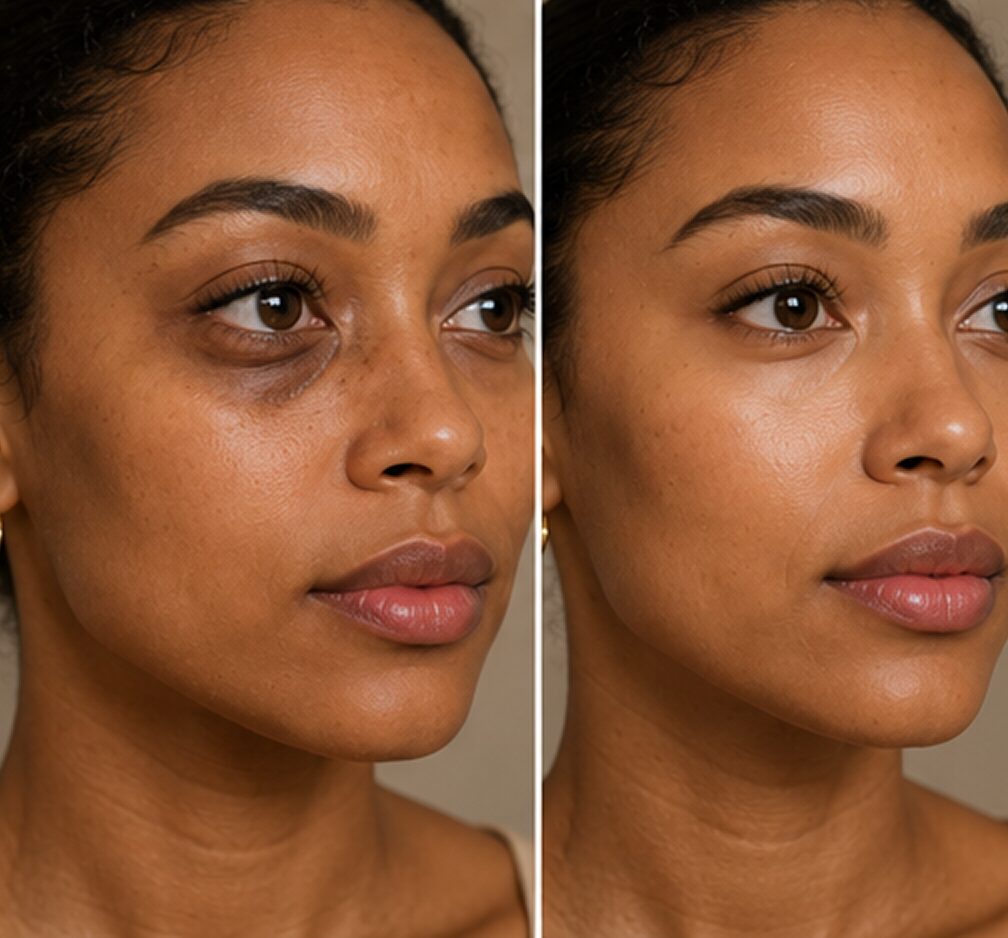
Tear trough filler
For clients whose primary concern is hollowness or a visible depression under the eye, tear trough filler is the most targeted option available. A small amount of soft, fluid hyaluronic acid filler is placed beneath the skin to support the tissue, reduce the shadow, and smooth the transition between the lower eyelid and the cheek.
When done correctly — conservatively, with appropriate product selection, and by a practitioner experienced in this specific area — the results can be significant. The under-eye area looks softer, more rested, and the shadow that’s been there regardless of sleep or hydration simply isn’t as pronounced.
When done incorrectly — with too much product, the wrong formulation, or insufficient anatomical knowledge — tear trough filler is one of the treatments most associated with visible, unnatural results. This is an area where practitioner skill matters more than almost anywhere else on the face. We approach it with a very conservative hand and always assess whether the midface, rather than the tear trough directly, is the more appropriate treatment point.
How long does it last? Tear trough filler typically lasts twelve to eighteen months, though results vary. The under-eye area tends to metabolise filler more slowly than areas like the lips, which can work in favour of longevity.
Polynucleotides
For clients whose under-eye concern is more about skin quality — crepiness, fine lines, dark circles driven by thin or translucent skin rather than hollowness — polynucleotides are one of the most effective non-surgical options available.
Injected superficially into the skin beneath the eye, they stimulate collagen and elastin, improve skin thickness and hydration, and reduce the transparency that makes blood vessels visible. Results build gradually over four to eight weeks following each session, and improve further with a course of treatment.
Polynucleotides and tear trough filler are not mutually exclusive. For clients with both hollowness and skin quality concerns, using both — correctly sequenced — tends to produce the most complete result. (For more on polynucleotides specifically, see our full guide to polynucleotides treatment at Crystalline.)
Skin boosters
Products like Profhilo, when injected in small amounts into the periorbital area by an experienced practitioner, can improve skin hydration and quality around the eyes. The effect is subtler than polynucleotides in this area and not all skin boosters are suitable for use this close to the eye — product selection and technique matter significantly here.
For clients with mild crepiness and dehydration rather than significant hollowing or pigmentation, skin boosters can be a good entry-level option for the under-eye area, particularly if they’re already receiving skin booster treatment elsewhere on the face.
PRP
Platelet-Rich Plasma — where growth factors from your own blood are injected into the skin — has shown genuine efficacy in the periorbital area for improving skin quality, reducing the appearance of dark circles caused by pigmentation and thin skin, and stimulating collagen over time. It works particularly well for clients with more complex under-eye concerns involving multiple causes simultaneously.
The results from PRP build slowly — typically over three months following a course of treatment — but tend to look very natural precisely because the improvement is driven by the skin’s own biology. (See our guide to PRP at Crystalline for a full breakdown of the treatment.)
What Won’t Fix Under-Eye Concerns

Eye creams. We’ll be straightforward about this. No topical product, however high-end, can penetrate deeply enough to address a structural hollow, stimulate meaningful collagen in skin that’s already thinning, or reduce blood vessel visibility. They’re not without value — keeping the skin moisturised supports its barrier function — but as a solution to the concerns described above, they have real limits.
The same applies to sleep, hydration, and diet, which are frequently cited as remedies for dark circles. They help. They’re not enough on their own for the majority of people we see in clinic.
What to Expect at a Consultation
When a client comes to us with under-eye concerns, we don’t start with a product recommendation. We start with an assessment.
We look at whether the concern is structural (hollowing, loss of midface volume), skin quality-based (thinness, crepiness, pigmentation), vascular (visible blood vessels through translucent skin), or a combination. The answer shapes everything about the treatment approach — what we recommend, in what order, and at what interval.
This is not a straightforward area to treat, and we’d rather take the time to do it properly than move quickly and produce a result that doesn’t hold up.
For independent guidance on injectable treatments around the eyes, the Save Face register provides a list of accredited, registered practitioners across the UK. The British Association of Aesthetic Plastic Surgeons also offers useful context on non-surgical treatments in this area.

Ready to Find Out What Your Under-Eye Area Actually Needs?
Book a consultation with our team at Crystalline. We’ll give you an honest, detailed assessment of what’s happening under your eyes, what’s driving it, and which treatment or combination of treatments is most likely to produce a result you’re actually happy with.
No guesswork. No overselling. Just a clear plan built around your specific anatomy.